Psychological Safety in the Workplace
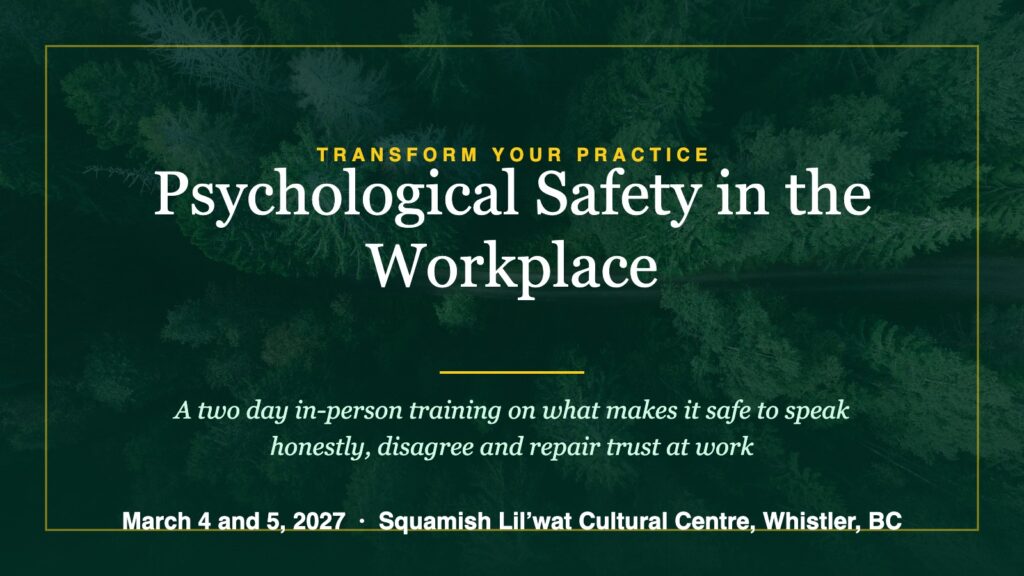
A Transform Your Practice offering Belonging is about being welcomed in. Psychological safety is about what happens once we are there: the confidence that we can speak honestly, disagree, name harm, admit a mistake and ask for help without paying for it later. Over two days in Whistler, we explore what makes that possible, and what quietly makes it impossible. What we will look at How power moves through a team What happens in our bodies during conflict Why people go quiet, and what their silence is telling us How fear of getting it wrong keeps us from saying anything at all What repair asks of us once trust has been broken The conversations many of us avoid, including feedback, disclosure, boundaries and accountability, which we will practise together What you will leave with Language for what you have been noticing A clearer read on your own patterns under pressure Practical ways to help the teams and workplaces you belong to become places where people can share what they are seeing and living sooner, and be met well when they do Optional half day, March 6 For those who want to go further, an optional half day offers immersive small group work. It is an additional cost, with details and pricing to follow. Details Series: Part of Transform Your Practice, Myrna McCallum’s in-person and online training for workplaces Dates: Thursday, March 4 and Friday, March 5, 2027 Location: Squamish Lil’wat Cultural Centre, Whistler, BC Included: breakfast and lunch on both days. Dinner and lodging are on your own. Investment All rates are in Canadian dollars. GST is added at checkout. Founding rate: $2,299 + GST, through October 31 Early bird: $2,699 + GST, through December 15 Standard rate: $2,999 + GST Bringing your team: every seat after the first is $500 off. Two seats save $500, four seats save $1,500. Invoicing is available for organizations. To book more than one seat, email admin@myrnamccallum.co. Payment plan: a $999 + GST deposit holds your seat at the rate in effect that day, with the balance paid in installments by January 15. Deposits are non-refundable and can be transferred to a colleague. For a deposit, a payment plan or an invoice, email admin@myrnamccallum.co. Seating is limited, so the room stays intimate enough for everyone to share. Whistler accommodations fill early, so we encourage you to book your stay as soon as you register. Questions? Reach us at admin@myrnamccallum.co
Full Fall Series – Bundle & Save
Bundle and save when you join us for the full fall series. Sessions run from 10am–12pm PT via Zoom Fri Sept 25: Assume the Wound: Trauma Responsive Foundations What if the behaviour isn’t the problem? When someone is defensive, withdrawn, angry, disengaged—or simply difficult—we often ask, “What’s wrong with them?” This foundational session invites a different question: “What brain state produced this behaviour?” We’ll explore the relationship between trauma, stress, threat and nervous-system dysregulation, and how these can shape the way people communicate, respond and connect. We’ll also consider what it means to practice trauma responsiveness in a culturally reflective way, recognizing that harm, healing and experiences of safety don’t look the same across every community, history or body. This is the shift from judgment to curiosity. Fri Oct 2: Capacity Conversations: Boundaries in the Workplace Boundaries aren’t simply about learning to say no. Our ability to recognize and communicate our limits is shaped by relationships, expectations, workplace culture, power—and our nervous system. Sometimes what looks like defiance, disengagement or poor performance is actually a signal that someone has reached the limits of their capacity. In this session, we’ll explore the difference between capacity, willingness and availability, why we sometimes override our own limits until we reach exhaustion or resentment, and how to communicate boundaries without unnecessary defensiveness or relational threat. Most importantly, we’ll practice having more honest conversations about workload, expectations and what is actually sustainable. A boundary isn’t simply a limit you set. It’s information about what you can sustainably carry. Fri Oct 9: Reframing Conflict: From Disruption to Data Conflict is often treated as a problem to solve, a disruption to manage, or something to shut down as quickly as possible. But what if conflict is telling us something? Every conflict carries information. It may point to an unmet need, a boundary that has been crossed, a nervous system in protection mode, or different experiences of what feels normal, fair or safe. In this session, we’ll learn to look beneath the presenting conflict for the information underneath it. We’ll explore how conflict escalates, recognize the early signals that often get missed, and consider how to interrupt the pattern before it becomes rupture. The goal isn’t to make conflict disappear. It’s to become more skilled at reading what conflict is telling us—so we can respond to what’s actually happening. Fri Oct 16: From Belonging to Challenging: Psychological Safety in the Workplace Belonging asks: Do I have a place here?Psychological safety asks: Can I be honest here? Psychological safety isn’t about comfort or agreement. It’s about creating the conditions where people can speak up, disagree, challenge ideas, ask for help and tell the truth—even when the truth is uncomfortable. In this session, we’ll move beyond understanding psychological safety to explore what it actually takes to make disagreement and truth-telling possible. We’ll look at how leaders respond to challenge, how to surface difficult information without creating unnecessary relational threat, and practical ways to navigate disagreement without shutting people down. Because the goal isn’t harmony at all costs. It’s creating workplaces where people can challenge, contribute and still belong. Fri Oct 23: Beyond Burnout: Your Nervous System Is Speaking to You We often treat burnout as a productivity problem—something to fix with better time management, greater efficiency or a lighter workload. But sometimes the problem isn’t that we’re doing too little. It’s that our nervous system has been doing too much for too long. This session explores the physical and emotional signals of depleted capacity that can easily be dismissed as laziness, moodiness, disengagement or a bad attitude. We’ll look at how stress and nervous-system load affect our capacity to think, connect, communicate, make decisions and recover. We’ll also consider how culture, work and our responsibilities shape what rest and recovery are actually allowed to look like. This isn’t a generic wellness checklist. It’s about learning to recognize the signals—and respond before exhaustion becomes your normal. Come for what you need. Leave with something you can use.
Reframing Conflict: From Disruption to Data
Conflict is often treated as a problem to solve, a disruption to manage, or something to shut down as quickly as possible. But what if conflict is telling us something? Every conflict carries information. It may point to an unmet need, a boundary that has been crossed, a nervous system in protection mode, or fundamentally different experiences of what feels normal, fair or safe. When we focus only on stopping the conflict, we can miss what it is trying to tell us. In this two-hour Practice Session, we’ll learn to look at conflict differently. We’ll explore: What conflict is telling us — how to look beneath the presenting issue for the information underneath it. The nervous system and conflict — what happens when people move into protection, threat or reactivity. How conflict escalates — recognizing the progression from the first spark to full escalation. The early signals — identifying opportunities to interrupt the pattern before conflict becomes rupture. Responding instead of reacting — practical ways to stay curious and work with the information conflict is providing. This isn’t about avoiding conflict or learning how to make conflict disappear. It’s about becoming more skilled at reading what conflict is telling us—so we can respond to the underlying issue instead of simply reacting to the disruption. You’ll leave with a different way of understanding conflict, greater awareness of the moments when escalation begins, and practical strategies for interrupting the pattern before it causes deeper harm. October 9, 202610:00 AM–12:00 PM Pacific TimeVirtual via Zoom$399 + GST (Stripe registration fee applies if paying via credit card) No series commitment required.
Capacity Conversations: Boundaries in the Workplace
We often think of boundaries as something we need to set—learn to say no, protect our time, and communicate our limits. But boundaries are more complicated than that. In the workplace, our ability to set and maintain boundaries is shaped by power, relationships, expectations, culture and, often, our nervous system. Saying “I can’t take this on” can feel very different depending on who is asking, what is at stake, and whether we believe it is actually safe to be honest about our capacity. This two-hour Practice Session explores the connection between capacity, boundaries and workplace relationships. We’ll look at: What capacity really means—and how it differs from willingness or availability How stress and nervous-system load can affect our ability to recognize and communicate our limits Why we sometimes override our own capacity until we reach exhaustion or resentment How to communicate boundaries without unnecessary defensiveness or relational threat Practical language for having honest conversations about workload, expectations and limits How to respond when someone tells us they have reached capacity This isn’t about building better walls or learning to say “no” more often. It’s about learning to have honest conversations about what we can sustainably carry—and creating workplace relationships where those conversations are possible. You’ll leave with a clearer understanding of capacity, greater awareness of your own limits, and practical language for navigating boundary conversations with more clarity, confidence and care. October 2, 202610:00 AM–12:00 PM Pacific TimeVirtual via Zoom$399 + GST (Stripe registration fee applies if using a credit card) No series commitment required.
Beyond Burnout: Your Nervous System Is Speaking to You
What if burnout isn’t a failure of productivity—but a signal from your nervous system? We often respond to exhaustion by trying to do better: manage our time, become more efficient, push through, take a few days off and get back to work. But sometimes the problem isn’t that we’re doing too little. It’s that our nervous system has been doing too much for too long. In this two-hour Practice Session, we’ll explore what happens when chronic stress, emotional demands and sustained pressure begin to affect our capacity to think, connect, communicate, make decisions and recover. We’ll pay attention to the signals we often dismiss or misinterpret: exhaustion irritability withdrawal difficulty concentrating feeling overwhelmed reduced capacity emotional reactivity the sense that even ordinary things have become too much These experiences can easily be labelled as laziness, moodiness, disengagement or a bad attitude when they may actually be signs that the nervous system is struggling to keep up. We’ll also explore an important question: What does recovery actually look like when your life, work and responsibilities don’t allow you to simply “rest”? Our ideas about productivity, capacity and rest are shaped by culture, work, identity and the environments we live in. This session moves beyond generic wellness advice to consider what sustainable capacity and recovery can look like in real life. You will leave with: A better understanding of your nervous system’s signals, greater insight into the difference between stress and depleted capacity, and practical strategies for responding before exhaustion becomes your normal. Burnout isn’t your body letting you down.It’s information about what your body has been carrying. October 23, 2026 10:00 AM–12:00 PM Pacific TimeVirtual via Zoom$399 + GST (Stripe registration fee applies if using a credit card) No series commitment required.
From Belonging to Challenging: Psychological Safety in the Workplace
Most organizations understand the importance of belonging. But belonging is not the same as psychological safety. You can feel welcomed, valued and included—and still hesitate to disagree with your manager, challenge a decision, raise a concern, admit a mistake or tell the truth when something isn’t working. Psychological safety asks a harder question: Can I be honest here? In this two-hour Practice Session, Myrna McCallum will explore what psychological safety actually means—and what it takes to create the conditions where people can speak honestly, challenge ideas and engage in meaningful disagreement. This is not a session about avoiding conflict or making everyone comfortable. Psychological safety does not mean that everyone agrees. It means people can express disagreement, concerns and difficult truths without fear of humiliation, punishment, exclusion or retaliation. Together, we will explore: What psychological safety is—and what it isn’t The difference between belonging and psychological safety Why people become silent in workplaces How power and hierarchy influence what people are willing to say What makes disagreement feel risky How to challenge ideas without unnecessarily threatening relationships How leaders can respond when someone challenges them Practical strategies for making truth-telling and disagreement possible How to create conversations where candour, curiosity and accountability can coexist This will be a practical and participatory session, not simply a lecture. We will look at real-world workplace dynamics and consider what we can do differently when conversations become difficult. You will leave with: A clearer understanding of psychological safety, a framework for recognizing what gets in the way of honest communication, and practical strategies you can begin using immediately to make disagreement and truth-telling more possible in your workplace. From belonging to challenging.From silence to honesty.From avoidance to accountability. October 16, 2026 2-hour virtual workshop with Myrna McCallum$399 + GST (a Stripe registration fee applies if paying via credit card) No series commitment required.
Assume the Wound: Trauma Responsive Foundations
The Practice Sessions with Myrna McCallum2-hour virtual workshop What if the behaviour isn’t the problem? The withdrawal.The defensiveness.The anger.The disengagement.The conflict. When someone behaves in ways we find difficult, we often ask: “What’s wrong with them?” But what if we asked a different question: “What brain state produced this behaviour?” This is the shift from judgment to curiosity. We often judge behaviour without considering the state of the nervous system behind it. But behaviour doesn’t happen in a vacuum. Stress. Threat. Trauma. Dysregulation. These can all shape how someone communicates, responds, connects and makes decisions. Trauma responsiveness asks us to look beneath the behaviour. In this session, we’ll explore: Trauma & the nervous systemHow nervous system dysregulation can influence behaviour, relationships and communication. From personality to brain stateWhat gets labelled as a “difficult person” may actually be a response to stress, threat or trauma. Trauma-responsive practiceHow to respond differently without becoming someone’s therapist. Psychological safetyHow understanding brain states can help us create workplaces grounded in greater psychological safety, trust and choice. Culturally reflective practiceRecognizing that harm, healing and our experiences of safety don’t look the same across every community, history or body. Come for what you need.Leave with something you can use. September 25, 202610:00 AM–12:00 PM Pacific TimeVirtual via Zoom $399 + GST (Stripe registration fee applies if paying with cc) No series commitment required.
Transform Your Practice: Beyond Right & Wrong: Cultural Humility, Non-Judgment, & Embodied Awareness Lunch & Learn
July 20, 10-11:30 AM PST In this 90 minutes online session participants will examine how binary thinking (e.g., right/wrong, good/bad, healthy/unhealthy) can reinforce judgment and act as a barrier to cultural humility, limiting our ability to engage with others in a trauma-responsive way. This session encourages greater curiosity, attention to context, and comfort with complexity in our interactions, while inviting creativity in how we respond to ourselves and others. Who This Is For Individuals and organizations seeking to deepen cultural humility as a reflective, practice-based approach. It is especially relevant for those who: Navigate complex interpersonal dynamics and decision-making Want to move beyond “right vs. wrong” frameworks in their work Are interested in strengthening self-awareness and regulation in their professional and personal practices. Learning Objectives By the end, participants will: Understand cultural humility as an ongoing practice rather than a fixed competency. Recognize how binary thinking (right/wrong, good/bad) shapes judgment of others and their own self. Explore how control and judgment are often linked to nervous system dysregulation. Have simple somatic tools for self-regulation and reflection.
Transform Your Practice: Psychological Safety Virtual Course
Aug 7 ,14, 21 | 10:00am – 12:00pm PT Workplace conflict is often treated as a disruption to be managed or resolved quickly. But what if conflict is actually data—revealing deeper issues related to trust, safety, power, and unmet needs? This 3-part virtual training invites you to rethink how you understand and respond to conflict in your organization. Grounded in trauma-informed principles and a focus on psychological safety, this series will support you in moving beyond surface-level responses toward practices that build trust, strengthen relationships, and foster accountability. What We’ll Explore Session 1 (August 7): Reframing Conflict — From Disruption to Data Understanding conflict beyond “problem people” narratives The role of trauma, stress, and power in workplace dynamics Psychological safety: what it is and what it is not Common missteps in conflict response Session 2 (August 14): Trust, Harm, and Accountability in Practice How trust is built, broken, and repaired Moving beyond intent to understand impact Why traditional approaches often erode trust Accountability as a pathway to repair, not punishment Session 3 (August 21): Building Psychologically Safer Systems and Relationships Embedding safety into policies, processes, and leadership Communication strategies that de-escalate conflict Designing systems that center dignity and fairness Practical steps for sustaining culture change These are 6 hr programs split into three 2 hr segments. They will be recorded and the recordings will be provided to registrants for a limited time following the program. The fee is $900 plus GST
Transform Your Practice: Allyship to Accountability Course
Aug 5, 12, 19 | 10:00am – 12:00pm PT Session 1 (Aug 5): From Allyship to Relationship Where self-awareness meets what allyship has actually looked like in practice. We explore the difference between allyship as a label and relationship as a lived practice — and name the patterns, like extractive practice, that keep people stuck at the label. What allyship means to you — and where that understanding came from Privilege, bias, and lived experience: how our position shapes what we notice Extractive practice: when we take without giving back Relationship, reciprocity, and humility as the alternative to allyship-as-identity Session 2 (Aug 12): Power, Silence, and the Space Between Intention and Impact Building the self-regulation to stay present when impact and intention don’t match. This session names what quietly blocks relationship — even among people with good intentions. How power and privilege operate quietly in everyday interactions Intention vs. impact: why good intentions don’t neutralize harm Bystanding, tokenism, and silencing — the ways we avoid discomfort instead of staying present Recognizing your own patterns, in real time, without collapsing into shame Session 3 (Aug 19): From Performance to Practice Relational capacity as a lived practice — responsibility, reciprocity, repair. This is where the series turns from naming the problem to practicing the alternative. Responsibility: owning impact regardless of intention Reciprocity: relationship as a two-way exchange, not a one-way act of generosity Repair: what actually happens after harm — the part most people skip What it looks like to be in relationship, not just accountable, the next time you get it wrong These are 6 hr programs split into three 2 hr segments. They will be recorded and the recordings will provided to registrants for a limited time following the program. The fee is 900 plus GST payable.