Psychological Safety in the Workplace
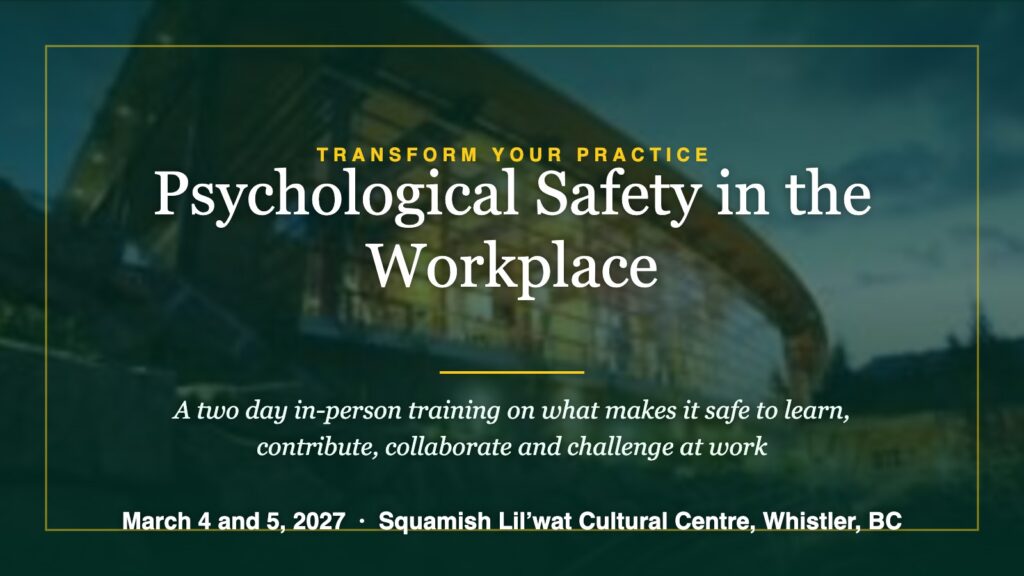
A Transform Your Practice offering Belonging is where psychological safety begins, not where it ends. Being welcomed in matters. What matters just as much is what happens once we are there: whether we feel safe to learn out loud, to contribute what we actually think, to collaborate without guarding ourselves, and to challenge the way things have always been done. Many teams stop at belonging. People feel included, but they still hold back the question that would reveal what they don’t know, the idea that might not land, the concern that might cost them. That holding back is where mistakes go unnamed, harm goes unaddressed and good people quietly disengage. Over two days in Whistler, and drawing on Timothy R. Clark’s four stages of psychological safety, we look at all four: belonging, learning, collaboration and challenge. We explore what makes each one possible, what quietly shuts it down, and what we can each do, whatever our role, to build teams where people say what they see sooner and are met well when they do. What we will look at How power moves through a team What happens in our nervous systems during conflict Why people go quiet, and what their silence is telling us Building teams where getting it wrong is invited, so mistakes become part of how we learn rather than something we hide The steps it takes to repair when trust has been broken Meeting difficult conversations involving disclosures, boundaries and accountability What you will leave with A 30-day plan for going back to work: one practice you will start, one pattern you will interrupt, and a clear measure so you can tell whether the shift is working. A way to see how power moves through a team: who speaks first, who gets interrupted, whose ideas get credited, and what that tells you about who feels safe. Questions to ask when a team goes quiet, so silence becomes information rather than something you assume means agreement. Tools to recognize fawning, freezing and flight when they are operating in team meetings and conversations, in yourself and in the people around you. A way to see when trust has been eroding within a team, and strategies for beginning a repair process grounded in the principles of Nonviolent Communication. Optional half day, March 6 For those who want to go further, an optional half day offers immersive small group work. It is an additional cost, with details and pricing to follow. Details Series: Transform Your Practice series. Dates: Thursday, March 4 and Friday, March 5, 2027 Location: Squamish Lil’wat Cultural Centre, Whistler, BC Included: breakfast and lunch on both days. Dinner and lodging are on your own. Investment All rates are in Canadian dollars. GST is added at checkout. Paying by credit card? Stripe, the company that processes card payments, adds its own processing fee at checkout on top of GST. That fee is collected by Stripe, not by us. Prefer to avoid the card fee? You can pay by e-transfer to admin@myrnamccallum.co with the password “loveback”. Include your full name and “Psychological Safety in the Workplace” in the message. Founding rate: $2,299 + GST, through October 31 Early bird: $2,699 + GST, through December 15 Standard rate: $2,999 + GST Bringing your team: once two seats from your organization are confirmed, every additional seat is $300 off. A team of four saves $600, a team of five saves $900. Invoicing is available for organizations. To book as a team, email admin@myrnamccallum.co. Need an invoice for your organization? Choose Pay by invoice or cheque at checkout. Your registration is recorded and your seat is held right away, and we email your invoice within two business days. Payment plan: a $999 + GST deposit holds your seat at the rate in effect that day, with the balance paid in installments by January 15. Deposits are non-refundable and can be transferred to a colleague. For a deposit, a payment plan or an invoice, email admin@myrnamccallum.co. Seating is limited, so the room stays intimate enough for everyone to share. Whistler accommodations fill early, so we encourage you to book your stay as soon as you register. Questions? Reach us at admin@myrnamccallum.co
LoveBack™ Retreat: The Pain We Carry Into the Workplace
This is a working space, not a therapy space. We are not here to process your history. We are here to understand how it moves through your work, and what to do about that. Intergenerational harm does not stay in the past, and it does not stay at home. It shows up in how we communicate, how we lead, what we tolerate and what we repeat. In our communities it often surfaces as lateral violence, harm passed sideways between people who are already carrying too much. Left unnamed, it shapes teams, careers and relationships. Named, it can be worked with. Many of us are doing demanding work while living with complex trauma. It affects how we hear feedback, how much we take on, when we go quiet, and how we treat the people we lead. This retreat treats that as a professional reality rather than a private problem. Over three days we work through The Pain We Carry Workbook by Natalie Y. Gutiérrez, the companion to her book The Pain We Carry: Healing from Complex PTSD for People of Color. Natalie guides us through it, Myrna connects it to the places we spend our working lives, and every participant receives their own copy to keep. What we will look at How complex trauma operates in professional settings, and how it shapes communication, leadership and conflict Ancestral and intergenerational burdens, and how they travel through families, workplaces and communities Lateral violence: what feeds it, how to recognise it early, and how to interrupt it What it costs to be the only one in the room who looks like us, and how we carry that What repair actually asks of us, with ourselves, our colleagues, our families and our communities Regulation, boundaries, and staying steady in the conversations most of us avoid What you will leave with Language for what you have been noticing in yourself and in your workplace A clearer read on your own patterns under pressure Practical strategies for repair you can use at work, at home and in community Your own copy of The Pain We Carry Workbook, to keep working with long after Royston A small circle of people who understand the rooms you walk into Who this is for People whose work brings them close to other people’s wounds, and who are carrying their own: Leaders, managers and team leads Helpers, healers and frontline workers Advocates and community organizers Legal and health professionals Educators, social workers, and child and family workers Anyone responsible for a team where harm has shown up This work was built for and with communities of colour. It draws on Natalie’s decolonial practice with people of the global majority and on Myrna’s LoveBack™ methodology, developed for and with Indigenous communities. You do not need to have figured anything out to belong here. You need only be ready. The team holding this space Myrna McCallum, co-facilitator Métis and Cree trauma educator, lawyer and speaker, and the creator of LoveBack™, a methodology rooted in the belief that love is not soft, it is the most radical act of resistance available to us. Myrna has spent her career at the intersection of trauma, justice and centering humanity. Natalie Y. Gutiérrez, LMFT, co-facilitator Puerto Rican trauma therapist, ancestral healer, Certified Internal Family Systems therapist and international keynote speaker, with 17 years specializing in complex, racial, multigenerational and ancestral trauma. Author of The Pain We Carry and its companion workbook, with work featured in the Washington Post, the LA Times and NPR. More at natalieygutierrez.com. Moana Paulus, healer A Polynesian healer with roots in New Zealand and Hawaii. Moana offers individual one-to-one healing sessions during the retreat, personal care alongside the group work. Charmaine Parenteau, Resident Auntie Métis from Duck Lake, Saskatchewan, Treaty Six territory, and Resident Auntie for LoveBack™ programs. She brings humour, warmth and an unshakeable sense of care. Every retreat needs an Auntie. We are lucky to have ours. Practical notes This is professional development. It is not treatment, and it does not replace therapy or clinical care. Natalie is a licensed therapist and is here as a facilitator, not as your therapist. Bring what you are willing to work with. Nothing will be asked of you that you do not choose to offer. Space is limited, so the room stays small enough for everyone to be heard. Venue The Kingfisher Pacific Resort & Spa sits on the traditional territory of the K’ómoks First Nation, on the eastern shores of Vancouver Island. It is a place of water, forest and beauty, a fitting container for the work we are coming together to do. The Kingfisher also offers healing caves and spa services. These are available to participants at their own cost and are not included in the retreat investment. When you book your room, please tell the Kingfisher you are booking a room for the LoveBack™ Retreat. They are offering a discounted rate to our participants, so it is worth asking for it when you reserve. Sponsor a seat Around the National Day for Truth and Reconciliation, people ask us what meaningful action looks like. This is one answer, and it holds all year. September 30 passes. What it asks of us does not. Allies and organizations can sponsor a seat for an Indigenous participant who wants to be in this room and cannot cover the cost. A sponsorship is $2,999 + GST, held at the founding rate for as long as sponsored seats are available. You will not attend on this ticket. We match every sponsored seat with someone who has asked to come, and we let you know when your seat is filled. When you sponsor a seat, you are also investing in a survivor’s business. I am an Indian residential school survivor, and this work is mine. Your sponsorship puts an Indigenous person in the room and supports the Indigenous-owned practice that built it. Reconciliation is also about where you choose to spend. If you are Indigenous and would like
An Invitation: A Creative Retreat for Women, Caye Caulker, Belize (Aug 24–28)
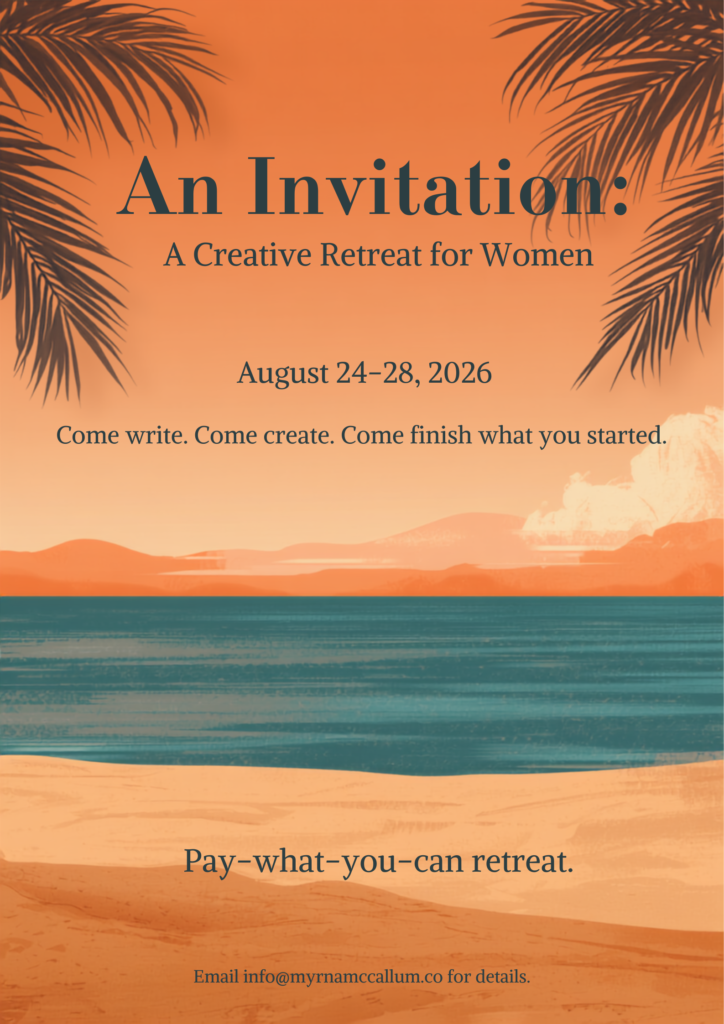
I’ve spent years looking for something like this — an Indigenous-led creative retreat where women could get away, write, create, and finally finish the project they keep putting off. I couldn’t find it. So I’m building it. You know how it goes. There’s always something — the kids need you, work won’t let go, the dog needs a walk, or the couch just wins. And the thing you actually want to create keeps getting pushed to “someday.” This is an invitation to stop pushing it off. What this is:A small, intentional gathering of 5-8 women coming together to write, create, and finish something that matters to them — in community, with structure, and with real accountability. This is a co-created space: group work, solo creative time, and a container held with care. This retreat lives under The Healing Imperative, my new initiative dedicated to fostering healing through creative expression and relationship-building. It grows out of years of work as a trauma-informed facilitator and lawyer, holding space for people to process, connect, and create. When:August 24–28, 2026 Where:Caye Caulker, Belize — a small, car-free island in the Caribbean, known for its slow pace and easy rhythm. I’ll be staying on the island for the duration, and I’ll share accommodation suggestions nearby so our group can stay close together while keeping our own private spaces. Investment:This is a pay-what-you-can retreat. I want this to be accessible, not exclusive — your presence and commitment matter more than what you’re able to contribute. You’ll be responsible for your own flights, accommodation, and meals; beyond that, you choose what feels right to offer for the facilitation and container. If this calls to you:Email me at admin@myrnamccallum.co and let me know you’re interested. I’ll send you the full program details and accommodation suggestions so you can start planning. Tell me what you’re working on. Tell me if this is the thing you’ve been putting off. I’d love to hold this space with you. Warmly,Myrna McCallummyrnamccallum.co